
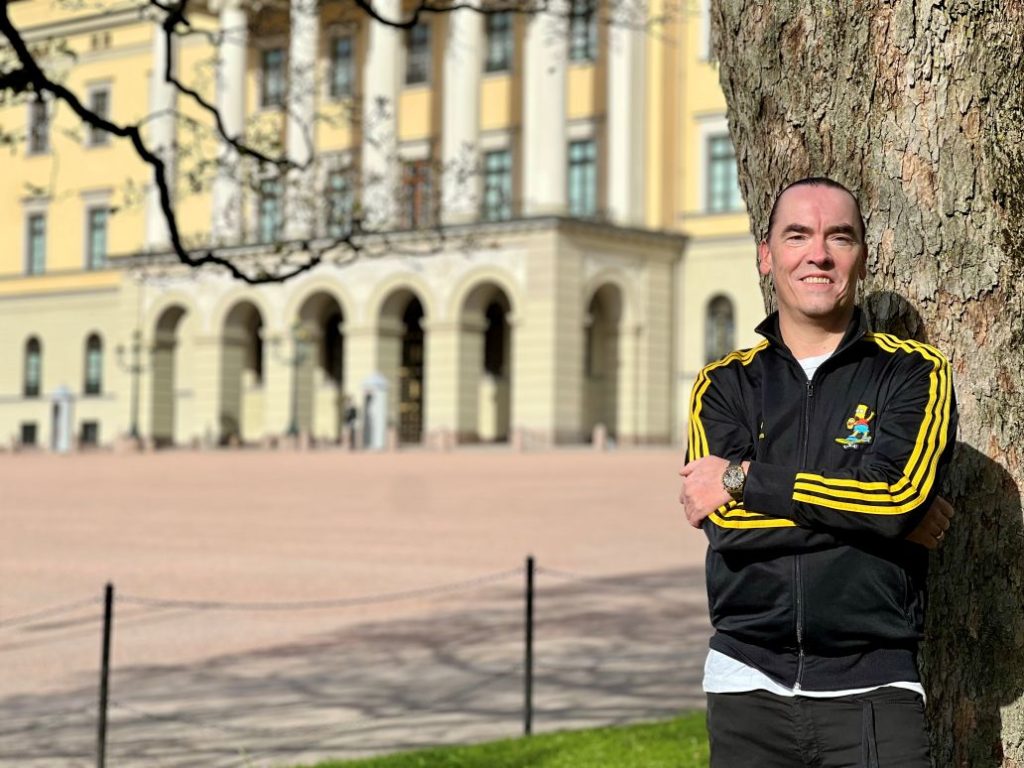
Norwegian ingredients at the Palace: Meet chef Nicolai Lundsgaard
As head chef at the Royal Court, Nicolai Lundsgaard manages a wealth of fantastic ingredients sourced from Norwegian small farmers and producers. He is the first in a new series of articles where we shine a spotlight on the symbiosis between chefs and farmers. Just don't ask Nico what the Norwegian royal couple likes best – he's not allowed to answer that.
Norwegian raw materials are central to the Palace
It's no secret that the Danish chef at the Royal Court is passionate about proper ingredients. That's all that's missing. When you're responsible for the royal couple's diet, it goes without saying that you don't want to serve them just any food.
Nicolai Lundsgaard is in this respect the right man in the right place. However, it is not only King Harald and Queen Sonja who will be dining at the castle. How important is it really for the royal family to use raw materials from small Norwegian producers and farmers?
– Let me put it this way: as a chef, I am committed to using small producers.
Especially when the castle has guests or state visits, it's fun to show what we have in Norway. I think it's important that we get to show off the farmer and the vegetables and everything we have locally. If it's a little far from Oslo, it's not that big of a deal, as long as it's Norwegian we're happy to get it.
serve it.
Nicolai Lundsgaard, “Nico” to those who know him, was born in Aarhus on what was probably a warm June day 52 years ago. The castle’s chef is essentially a smiling gentleman, so let’s assume that the rays of the June sun have contributed to that. At the age of 23, he moved to Stavanger and has lived in Norway ever since. His CV includes jobs at Tango and Craigs Kjøkken in the oil city in the west, and for a while he was at Eyvind Hellstrøm’s legendary restaurant Bagatelle, not too far from his current workplace.
There are many things a chef at the Royal Court is not allowed to comment on.
The position requires considerable discretion, but after 12 years he is well accustomed to dodging or talking around a number of questions. What the royal favourite dishes are, for example, is completely taboo to talk about.
– If I had spoken out about it, they would have received a lot of the same when they were out on assignment.
Small producers and farmers are important for the Palace's kitchen
Nico's job is threefold: He is responsible for the canteen for the palace's employees, he is responsible for the royal couple's meals and diet, and he is responsible for the palace's many official dinners.
The royal court has no official policy that so much of what is served should come from Norwegian producers – small or large – but it is clear that this is in no way a disadvantage. Furthermore – and this is important – the palace’s website states that during the gala dinners that take place in the Great Dining Hall, four courses are usually served “based on Norwegian ingredients.”
– I have no quotas to follow, and am free to be creative. I am concerned that things should be good, and it is nice to be able to serve asparagus from Hvasser, for example. There is a lot we can use, and I have complete freedom, says the chef.
– It is also generally well received when we use Norwegian things.
The castle grows its own produce on Bygdøy
As many know, the castle is self-sufficient in some raw materials and has its own garden in the Castle Park. The kitchen also grows some raw materials on Bygdøy.
– What we grow is a little different from year to year. I always want to try some new things and I talk to the gardeners. Maybe there's a new potato variety I want to try or a new carrot variety, it's very free and not so fixed.
– But what do you actually grow, for example on Bygdøy?
– Well, we have some asparagus, we have beets, thyme, rosemary, currants, plums, some lettuce and various things.
– Fruit and vegetables in both places, right?
– Yes, and I try as best as possible to use everything we have. We don't want any waste. It may happen that the royal ship gets something if it goes out, so that most of it is used.
The Royal Navy's kitchen is not Nicolai Lundgaar's responsibility, but it is not unnatural that there is a certain amount of collaboration; both an exchange of raw materials and ideas. He also gets honey from the bees in Dronningparken, although this project is not under the auspices of the palace. In addition, a new cheese factory is being built on Bygdøy, which he looks forward to working on.
– We are not involved in it ourselves, but it will be very exciting. I also use a lot of Norwegian cheese at the castle. Norwegian producers have come a long way there. There is a lot of good cheese now, in all categories, says Nico. He knows what he is talking about. Nicolai Lundsgaard has acted as a taste judge in several competitions organized by HANEN, including the Cheese World Championship, Norway's Best Drink and the Norwegian National Championship in Honey, and can confirm that this has been important for staying up to date on new, exciting products.
Nico sometimes resorts to imported goods because he wants to use what he thinks is good, but that is one of the exceptions. A clear main rule is that the food served at the castle is Norwegian, and it is an advantage if it is locally sourced, but not a requirement. There is also a clear desire for as much organic farming as possible, but the chef is no fool as he understands perfectly well that it is often very expensive and correspondingly unprofitable.
He too has budgets to deal with. It is not as if the palace has unlimited funds at its disposal. It is one thing that the official dinners should promote the good Norwegian ingredients, but in everyday life things have to be a little different, as good as
at all possible.
– We have a canteen, so I have to think about finances. There is no pata negra there, so to speak, but at the same time we try to use suppliers like Strøm-Larsen and A. Idsøe for meat. Fish and shellfish are always Norwegian, even though we don't use shellfish in the canteen other than a few shrimps occasionally. Then we smoke our own salmon, for example. It's a lot about finances. I have to distinguish between the employees and the guests at the gala dinners.
When it is so important for the royal family to profile Norwegian food for foreign visitors, is it also the case that the names of the producers are printed on the menus, we wonder?
– No, it is not. We are not tied to any suppliers, and we cannot write that
We have bought fish or meat here and there, but I like to highlight it if we have a carrot from Bygdøy Kongsgård. We can mention what we have grown ourselves, but we do not have the opportunity to profile other producers.
– In what ways do you try to highlight the origin of the ingredients you use? For example, do you come out into the hall and present the dishes, or is it more discreet than that?
– It may happen that you are out serving and say something, but on official occasions the guests are a little more in focus than me. When I serve the royal couple privately, I can of course say more.
– You talk to the royal couple about the ingredients?
– Yes, we need to talk a little about the food they get and where the ingredients come from, Nico says meaningfully. He doesn't say more than that.
– There is a big and significant difference in the nationalities you get into the castle. Do you think about where the main guests come from, whether it is, for example, a head of state from Italy or one from Tanzania?
– Yes, I do, I think about it a lot. I don't want to cook food from the countries they're from, but I think about it.
– How do you set up the menu then?
– When we had a state visit from the Netherlands a few years ago, I thought about the old Dutch flag that had an orange stripe on top. So I made a carrot tartare with some mustard seeds and pickled ginger and ramson mayonnaise. I took that chance, and it was well received. That's how I can think.
– But not necessarily in terms of flavors and ingredients?
– No, we are quite free, but again I have to say that on state visits it will be very Norwegian. Then we have to use Norwegian fish and shellfish and meat and vegetables, there is a lot of focus on it being Norwegian. I think that is fun, because we really have something to be proud of,
especially when it comes to seafood. It's on the priority list when we have visitors. For official dinners, he rarely uses pork.
– I'm afraid of allergies and other things, and it's also the case that when it's supposed to be a bit royal and nice, I don't think it fits with a pig in the program. I love it myself, but I'll find something else.
– What do you serve the employees in the canteen then?
– If we have a state visit, we make lasagna and salad and bread and stuff like that, just regular staff food. Fish cakes with boiled potatoes maybe?
– But do they have choices? More hot dishes, a buffet? And I mean in everyday life. If I had worked in the administration at the castle and were going to have lunch, what would I have been able to choose from?
– We always have a hot dish or soup, and then we have a big salad buffet with everything. Then there are cold cuts and some smoked salmon, scrambled eggs and other, completely normal things.
– Like any other canteen, that is, only a little better maybe?
– Let me put it this way; I think they have a good time at the castle. No, we have a good time at the castle.
How does the Palace's chef find good producers?
Nicolai Lundsgaard cannot say which producers he buys from, but perhaps he can tell us whether he receives many inquiries from farmers and others with a desire for the royals and their guests and employees to enjoy the food they prepare?
– Yes, there are quite a few, and I think that's really nice. It's not everything I can catch myself. What's the best salad, or who has really good cauliflower, for example?
– What do you do yourself to find good producers? Do you go out a lot and visit farmers and others?
– I try to visit people as much as I can, and the last time I was in Stavanger privately I also visited some producers. I like to try to fit it in if possible. There is also a very good culinary environment in Oslo where you can quickly pick up on the latest trends.
things, where we talk together. So and so can get good mullets, and things like that. Then there are many producers who are good at using social media. I pick up things on Instagram and other places, but it's clear that it takes time and that it takes up my free time.
too. It's not enough to just be at work from eight to four. It helps to be happy with your job. Nico is that. He is inspired, excited and delighted by the good meals he eats and the good ingredients he tastes.
– The day I stop doing it, someone else will take over my job. I'm still very interested in finding good producers, and that's fun.
Norwegian cheese, cider and seafood are on the menu
He clarifies that the castle is not a major purchaser, and it is not essential for a farmer who wants to deliver his goods to the Royal Court to produce such an awful lot. As Nico says, he is flexible and can to a certain extent trade with whomever he wants,
even when it comes to small quantities. On a daily basis, he serves an estimated 50 to 80 people in the canteen. When 200
When guests are invited to a gala dinner, a generally larger volume is needed, but there are still some ingredients that he does not need in large quantities.
Is he loyal to his suppliers?
– Yes, I would say that, but at the same time I demand that things should be good, and I also think that it should be stable. I accept that people can make mistakes, because we all do. We can order the wrong fish or the wrong vegetable, or maybe someone delivers four boxes instead of two. That can happen. Nico can confirm that he has many suppliers who have delivered to the castle over a long period of time.
time, but of course can't say anything about who it concerns. The lesson for all hopefuls, however, seems to be that he is a quality-conscious man who appreciates a certain stability, just as much as he likes to try new things.
What happens when the royals are on a representative visit around the country and bring home a cheese or perhaps a piece of rakfisk that they think is a little extra tasty?
– It happens that they get those kinds of gifts, and then we sometimes take advantage of it. It's also a way to discover new producers, but I can't say much more about that.
– You probably can't say much about this either, but how involved is the royal couple in what you serve? Do you often discuss food?
– They are absolutely committed and interested. It's nice, because it keeps us in the kitchen busy so that we always have to stay on top.
When asked if guests are served a lot of Norwegian cider during gala dinners as an alternative to wine, Nicolai Lundsgaard answers that it happens sometimes, but that there is just as much focus on non-alcoholic drinks, both cider and different types of fruit juice.
– It also happens that we make something ourselves, but we don't have the capacity to make a lot.
Outside of work, Nico is a member of the Norwegian barbecue team led by his old boss from Stavanger, Craig Whitson. Every year they compete in Memphis, Tennessee, and over the years they have won many awards. Barbecue is a welcome respite for
the castle's chef. Then he relaxes and gets his mind elsewhere. That said, he sometimes takes his barbecue to work.
– Let me put it this way: everyone loves barbecue, including the royal family.
– Are there any Norwegian ingredients that you think are particularly suitable for the grill?
– I have to say that asparagus is very good to grill. It's also good with a heart salad, by all means, but my favorite is probably asparagus. When it comes to meat, I prefer pork or lamb, something with a good fat structure. And if I'm going to grill seafood, it has to be a crayfish, says Nico with a huge grin.
Are there any raw materials that he sees Norwegian farmers not producing to any great extent, that he would like to see produced more of?
– Tiny, tiny potatoes, like asparagus potatoes and plum potatoes. I have a producer outside Stavanger who supplies me with a little, but I wish there were more. I know why it's like that, why not many people do it. It's expensive, and it takes a lot of time. They're supposed to make money too, but I miss those tiny potatoes. It's good.
– Are there things you think Norwegian farmers are particularly good at?
– I think organic farming is gradually improving, which has been quite bad. Now I see it getting better, that it is something that many have become better at, but again, consumers have to be willing to pay for it too. The farmers are left with little money, so it is a bit challenging. But I think they are very good, and once you discover the different producers, you will always find a fantastic cauliflower here or a good broccoli there, or whatever. We have a lot of good things. Apart from the fact that Norwegian farmers could be better at organic, there is not much I would criticize them for, concludes the royal chef Nicolai Lundsgaard.